
I&P Education to Employment
Launched in 2021, I&P Education to Employment is an impact funding programme dedicated to businesses within the education ecosystem in Africa. Its aim is to improve access to quality education and strengthen the link between training and employment, in order to open up better prospects for young people.
The programme is the result of a strong partnership between I&P and committed organisations such as the Mastercard Foundation, the European Union and the Government of Monaco. It has also benefited from the technical expertise of Catholic Relief Services, 60 Decibels and Chancen International
- Calendar: 2021–2023
- Geography: Sub-Saharan Africa
- Sector: Education and training
- Size: €11.5 million
- Portfolio: 30 funded companies
A programme funded by
Focus
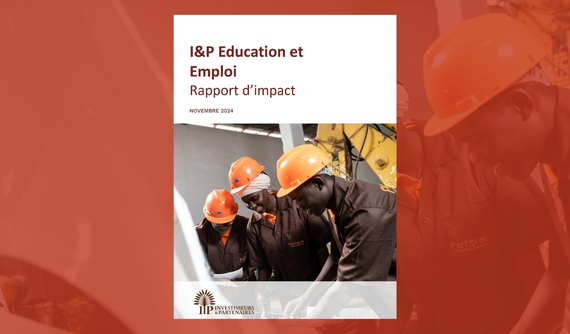
Latest programme impact report
The I&P Education to Employment impact report takes stock of three years of engagement with educational SMEs in Ghana, Senegal and Côte d’Ivoire. It documents the programme’s progress across six key areas: post-COVID resilience, the digitalisation of education, the quality of training, social inclusion, student wellbeing and the transition to employment.
Key figures include: 36,391 students enrolled at supported institutions, 19,067 taking online courses, 4,582 jobs created or safeguarded, and 1,000 grants awarded to students from disadvantaged backgrounds.
The programme in detail
Impact thesis
To propose impactful, innovative and tailored funding models designed to address the various challenges facing education in terms of quality, access and inclusion, with a view to promoting the employability and empowerment of young people in Africa.
Solution provided
- An additional investment approach, involving a rigorous due diligence process and strategic support to strengthen these organisations’ business models, with a view to ensuring their long-term financial sustainability and enabling them to scale up;
- Catalytic financing tailored to the education sector, made possible by a diverse range of concessional instruments (blended finance): interest-free loans, equity, quasi-equity, technical assistance, grants and matching funds, deployed according to need.
Key areas of impact
- Digitalisation – Developing a strategy to ensure an appropriate and effective digital transformation.
- Social inclusion – Developing mechanisms to facilitate access to education for vulnerable young people, particularly young women.
- Safeguarding – Developing policies and practices to ensure the effective protection of learners.
- Impact management – Measuring and monitoring the employment outcomes of graduates and programme participants.
- Advocacy – Promoting knowledge-sharing and dialogue amongst key stakeholders in the education sector.
Partners
The programme is supported by the Mastercard Foundation, the European Union and the Government of the Principality of Monaco as funding bodies, and by FERDI (Foundation for Studies and Research on International Development) as an academic partner.

The Mastercard Foundation works with visionary organisations to enable young people in Africa and in Indigenous communities in Canada to access decent and fulfilling work. It is one of the world’s largest private foundations, whose mission is to advance learning and promote financial inclusion in order to create an inclusive and equitable world. The Foundation was established by Mastercard in 2006 as an independent organisation with its own Board of Directors and management team.
The European Union Emergency Trust Fund for Africa was established in 2015 to develop a comprehensive approach to stability, security and resilience, and to prevent irregular migration and forced displacement. EU institutions, EU Member States and other donors have so far allocated €4.6 billion to the European Union Emergency Trust Fund for Africa. Through initiatives combining programmes for economic and social development cooperation, humanitarian aid and crisis response, the FFUE adopts an integrated security-development approach, providing a comprehensive and integrated response to the needs of the populations of the Sahel and Lake Chad regions.
The Prince’s Government of Monaco’s Development Cooperation policy, which has made the fight against poverty its priority, supports around 150 projects each year in 11 countries in sub-Saharan Africa and the Mediterranean. Aid focuses on four key areas essential for developing human capital: health, food and nutritional security, education and child protection, and access to decent work. Monaco allocates 1 per cent of its public budget to Official Development Assistance, 70 per cent of which is earmarked for the Least Developed Countries.
Established in 2003 on the initiative of CERDI (University of Auvergne and CNRS), the Foundation for Studies and Research on International Development (FERDI) aims to promote understanding of international economic development and the factors that influence it. It supports research activities that utilise the most modern and relevant tools of economic science for the study of development and seeks to strengthen Francophone capacity in this field.
Technical assistance partners
Our technical assistance partners work in the fields of digitalisation (Etudesk), social inclusion (Chancen International), advocacy (Catholic Relief Service) and impact measurement (60 Decibels):
