


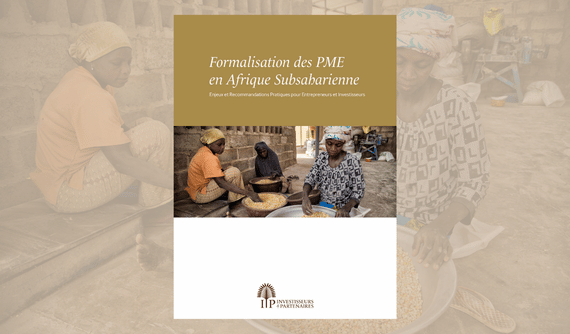
A few months after conducting two field studies involving several hundred employees in Madagascar and Senegal, I&P has published a summary report on the challenges and impacts of the formalisation of SMEs in sub-Saharan Africa.
This report is, first and foremost, a practical guide for entrepreneurs wishing to set up their businesses formally, and for investors and African governments seeking to promote a formal entrepreneurial sector.
Download the document:
Why should we be interested in this topic?
From the moment it was founded in 2002, I&P has been committed to supporting formal small and medium-sized enterprises, convinced that formalisation is essential for the long-term development of a business and brings numerous benefits for its employees. However, over the years, I&P has realised just how complex and difficult the formalisation process can be – and, in some cases, even impossible to carry out.
I&P has therefore carried out field studies and published this summary report to take stock of the issue and share the key lessons learnt. The report focuses on an aspect that is rarely analysed or discussed: the practical challenges businesses face on their path towards formalisation.
Our role as investors gives us access to unique knowledge and expertise, which are essential for understanding not only how businesses and their employees view public policy, but also what best practices exist for effectively guiding a business towards successful formalisation. This study will therefore be of interest to entrepreneurs embarking on such a process, as well as to private and public investors facing the challenges of moving out of the informal sector. We also hope that this work will inspire African governments, development agencies and researchers.” – Jean-Michel Severino, Chairman of the Supervisory Board.
The report is divided into three parts:
- An introductory section explaining the concept of informality, using key concepts and statistical data. It is thus pointed out that whilst informality exists on every continent, it is particularly high in sub-Saharan Africa, where more than 89 per cent of jobs are informal (ILO, 2018).
- The second part focuses on businesses and entrepreneurs. Whilst analysing the benefits of formalisation for businesses, we highlight that there are several reasons why businesses choose to operate informally. This section gives a voice to entrepreneurs, featuring several personal accounts. It also outlines the methodology gradually implemented by I&P to support businesses through their formalisation process.
- The third part focuses on employees in SMEs and seeks to understand the impacts – both positive and negative – that formal employment has on them compared with informal employment.
Reference: two I&P/FERDI studies on the informal economy in Madagascar and Senegal
Between August and October 2018, Investisseurs & Partenaires (I&P) and the Foundation for Studies and Research on International Development (FERDI) carried out two studies on the impacts of formal employment in Senegal and Madagascar. Nearly 500 employees were interviewed across 10 different companies, covering a range of sectors, hierarchical levels and types of employment contracts.
These studies have provided valuable insights for I&P. Whilst they have highlighted certain fundamental benefits associated with formalisation (job security, access to credit, social insurance, etc.), they also emphasise just how complex the issue is: the decision to formalise is far from straightforward for a small African business, and the formalisation process entails a number of drawbacks which, in some cases, can prove insurmountable for both entrepreneurs and employees.
With the publication of the summary report, I&P aims to disseminate the lessons learnt from these studies and share the best practices implemented by the team over the course of the investment period