


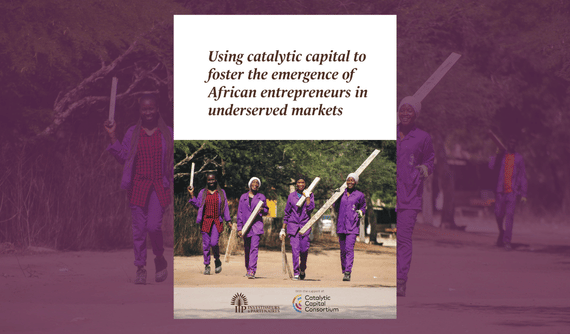
In this report, published in partnership with the Catalytic Capital Consortium, I&P highlights the effectiveness of catalytic capital in supporting African SMEs and sets out recommendations for expanding its use.
Download the executive summary
Drawing on a unique database comprising more than 255 African companies supported by I&P and on over 20 years’ experience in impact investing, in this report we highlight the crucial role of formal SMEs in promoting sustainable and inclusive growth in sub-Saharan Africa, as well as the barriers they face in accessing finance, and how catalytic capital offers a solution to address this lack of access to ‘conventional’ finance.
Ensuring that catalytic capital is better channelled towards African SMEs is a collective effort that must be undertaken by all stakeholders within the SME ecosystem. In this report, I&P shares some thoughts on how to take the deployment of catalytic capital a step further, thereby unlocking additional funding to support impact investment initiatives in Africa.
What is Catalytic Capital?
Catalytic capital is an essential tool for addressing the shortage of conventional funding and supplementing it
Catalytic capital can be defined as “loans, equity, guarantees and other investments that accept disproportionate risk and/or concessionary returns compared with a conventional investment, with the aim of generating a positive impact and enabling third-party investments that would otherwise not have been possible.” [Tideline Report, “Catalytic Capital: Unlocking More Investment and Impact”, 2019]
Catalytic capital therefore implies capital that is patient, risk-tolerant, concessional and more flexible than conventional financing.
Key takeaways
In particular, we highlight five key lessons, which are set out in greater detail in the report:
[1] I&P has demonstrated the long-term impact of SME financing through catalytic capital
- Private equity investment is a game-changer for SMEs, enabling them to achieve financial stability and significant growth
- I&P focuses on emerging markets that are underserved by investors, thereby maximising its impact where it is most needed
[2] The companies in the portfolio are performing well, but this economic success does not necessarily translate into a favourable valuation at the level of the investment fund
- SMEs triple their turnover on average after six years of investment
- However, investors face numerous challenges in translating this strong economic performance into financial value at fund level (premature redemptions, illiquid markets, currency depreciation, etc.)
[3] Catalytic capital is a key driver of the business model for impact funds, but structural constraints are hindering its expansion in Africa
- Funds dedicated to SMEs are finding it difficult to access the available catalytic capital
- The standards put in place in developed markets are not aligned with the needs and specific characteristics of emerging markets
- There is a twofold need: both quantitative (to unlock more catalytic capital) and qualitative (to improve the characteristics of the capital deployed)
[4] By incorporating greater flexibility into their financial and legal frameworks, investors could better support funds dedicated to SMEs and generate significant impacts
- Longer fund lifespans and evergreen structures enable SMEs to grow sustainably
- Grants, blended finance mechanisms and technical assistance support impact objectives
- Guarantee and co-financing mechanisms can reduce the risks for investors
[5] Funds must find ways to better demonstrate and highlight their impact
- Impact funds can improve impact measurement through the support of philanthropic investors and development finance institutions (DFIs)
- Propose innovative measures to assess social performance and evaluate internal aspects
Watch the video to find out the key points of the report
About the Catalytic Capital Consortium
The Catalytic Capital Consortium (C3) is an investment and learning initiative aimed at promoting greater and more effective use of catalytic capital, in recognition of its vital role in achieving the Sustainable Development Goals (SDGs) and realising the full potential of the impact investment sector. C3 is led by the John D. and Catherine T. MacArthur Foundation, Omidyar Network and the Rockefeller Foundation.
The aim of developing impact investment and promoting best practice lies at the heart of the C3 initiative. This partnership therefore represents an exceptional opportunity for Investisseurs & Partenaires (I&P), as an impact investor committed to improving access to finance, to advocate for this cause.